
(a grade-10 piece of work, the length seems appealing the image seem appealing so I put this on although the content is…blah!)
Abstract
Charles Manson was one of the most notorious murderers of the 20th century. He formed the Manson Family, a cult through which he carried out murders by proxy. The first part reviews Manson’s personal history and crimes, while the second part analyses Manson’s potential motives and causes from a different perspective.
1. Research Subject: Charles Milles Manson
1.1 Bio
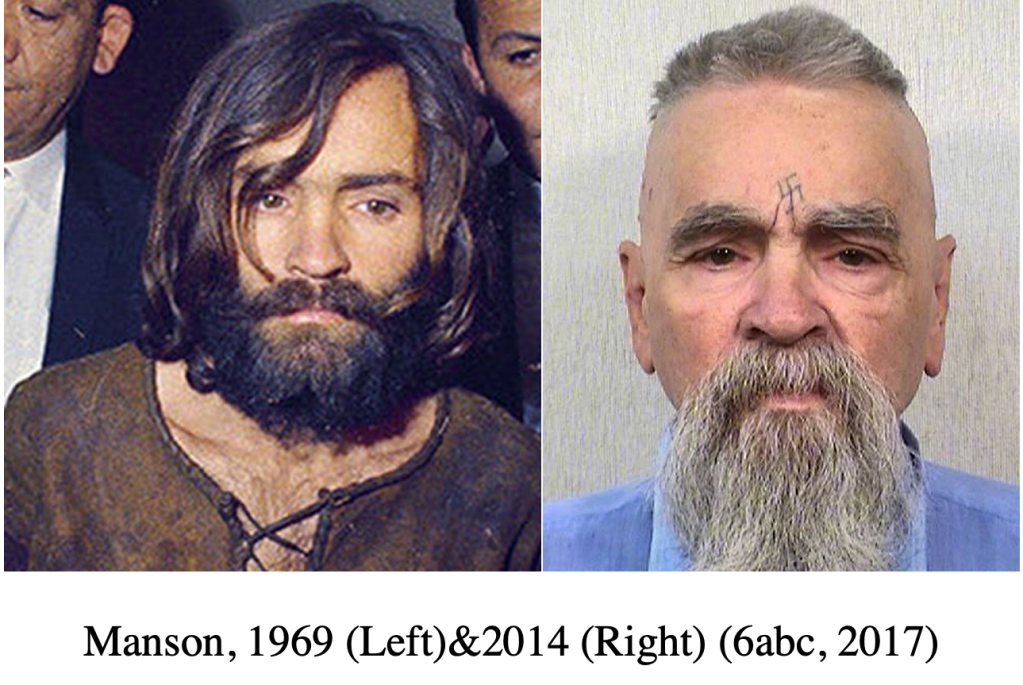
Charles Milles Manson was an American criminal who was born in 1934. After experiencing a fiasco in his music career, he initiated committing a series of crimes with the cult he formed in the late 1960s, the Manson Family (NBC News, n.d.). According to the statistics, Manson committed more than 9 murders, involving both direct and proxy murder, with the Manson Family and its members.
Instead of committing crimes by themselves like other infamous criminals, Manson seemed keener on manipulating his cult members and conducting murders via them. This pattern suggests that his ideology – which believed in white supremacy and intended to start a race war (Gill, 2017) – somehow influenced criminal activities more than his physical actions (People V. Manson, n.d.).
2. Early Experience
This chapter aims to briefly describe Manson’s early childhood experiences and provide an foundation which we can gain insight into his later criminal motivations from.
2.1. Childhood & Family life
Since he was born in 1934, Manson had an unfortunate childhood. He had two legally and biologically distinct fathers, the latter named Colonel Walker Henderson Scott Sr. (Internet Accuracy Project, 2012) who had a bad reputation in the area. In August 1939, Manson’s parents were imprisoned for assault and robbery (Guinn, 2013). While the parents were absent, Manson was housed with his aunt and uncle (Guinn, 2013). He was about five years old at the time. After her mother was paroled in 1942, she began to drink uncontrollably and commit further crimes (Guinn, 2013).
The absence of his parents and family dynamics laid the framework for his inadequate primary socialisation, which manifested in his subsequent early criminal experiences.
2.2. Early Crimes
Manson’s severe crimes began in 1968, but this chapter looks back at his early years and childhood crimes. In addition to occasional truancy, theft, and vagrancy, Manson used to set fire to his school on the worst occasion. He was then sent to a Catholic-run crime school – Gibault School for Boys (Gill, 2017). The school’s strict regime and the constant use of physical punishment to discipline students may also have set the stage for Manson’s later criminal behaviour.
However, Manson did try to get his life on track. He once worked for Western Union and delivered message for the firm, but he seemed unsatisfied with the wages he was receiving and resorted to stealing again to satisfy his desires (Hunter, 2015). Later, he even repeatedly escaped from school again and went back to his criminal ways (Bugliosi & Gentry, n.d.).
2.3. The Formation of the Manson Family
After Manson was released from prison in 1978, he formed the Manson Family in San Francisco (Edubirdie, 2021). As a new-fascism organisation, the “Manson Family” aimed to incite a race war. Most individuals who joined the organisation were well-being and involved celebrities (e.g. Dennis Wilson from The Beach Boys) (Dorsey, 2009). Some of the members were also appealed by the so-called “hippie culture” and “communal living” claimed by Manson (BBC News, 2017).
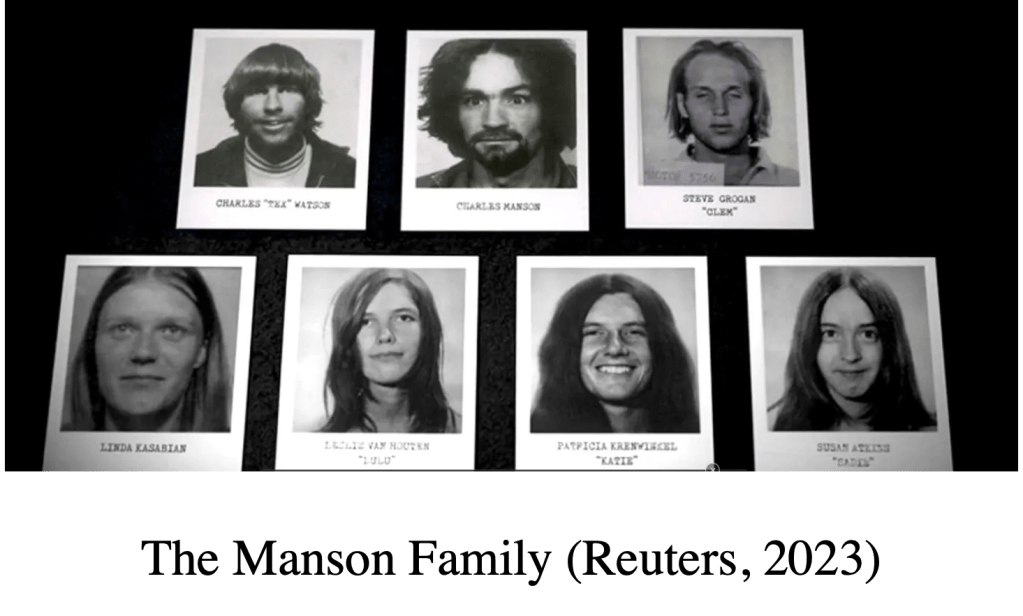
Manson then re-educated and manipulated his members who trusted these purported appearances, which led to the “Manson Family” playing an essential part in Manson’s subsequent criminal activities.
3. Crime Committed
This chapter examines one of the most iconic and socially influential crimes committed by Manson, namely the murder he and the Manson Family committed in 1969.
3.1. What happened: Tate–LaBianca murders
In 1969, approximately 7 people were murdered by the Manson Family in the Tate–LaBianca murders. Tate-LaBianca murders occurred in California on August 8th to 10th (Vox, 2019). Members of the Manson Family, under the direction of Manson, used stabbings and shootings to kill five people and two people, respectively, over two nights. Although these methods of killing are not unique, the “fervour” held by the cult members for the organisation throughout the case is worthy of our attention.

Tex Watson, the criminal group’s leader, claimed Manson instructed him to kill the victims as brutally as possible (“totally destroy”). Furthermore, during the murder, faced with panicked questioning from the victim (Frykowski), Watson simply replied, “I’m the devil, and I’m here to do the devil’s business.” (Bugliosi & Gentry, n.d.). In addition to this, the victims were tied together with ropes and hung on a beam in the living room by members of the Manson Family; one victim’s tendon was also cut; the women were even asked to move the car to help the members (Bugliosi & Gentry, n.d.).
According to writer James Day, Manson also attempted to directly kill the drug dealer Bernard Crowe (Waxman, 2019) (but he ultimately survived (Bugliosi & Gentry, n.d.)) in 1969 with a firearm, whilst the cult members murdered the remaining victims.
3.2. Trial & Sentences
On July 15 1970, Manson and his peers were indicted for murder and brought to court (Fox News, 2015). Nine and a half months later, the verdict was finally released: the four cult members directly involved in the murders were sentenced to death (Bugliosi & Gentry, n.d.), while Manson was sentenced to life imprisonment for non-direct involvement in the murders and entered the Los Angeles State Penitentiary to serve his sentence on April 22, 1971 (Bugliosi & Gentry, n.d.).
4. Motivation & Cause Analysis
This chapter analyses Manson’s motive for the crime in different perspectives.
4.1. Lombroso’s Criminology: Biological Determinism
Based on Cesare Lombroso’s criminal theory, certain physical traits such as “cold, glassy stares, bloodshot eyes, and big hawk-like nose (Brookes, 2022)” which may suggest that his or her criminal behaviours could be determined biologically can be identified in an individual.
The mug shot was taken in 1971 when Mason was sent to California (Manson, n.d.). In the photograph, we can extract some of his facial characteristics: Ⓐ a symmetrical face, Ⓑ standard features (eyes, mouth and ears), Ⓒ and smooth skin – the look of a “good man”. We do not seem to be able to identify the physical features that the criminal described in Lombroso’s theory has with Manson’s facial features in this picture. This analysis likely suggests that later experiences are more likely to lead to Manson’s Crime instead of innately-determined criminal behaviour.

4.2. Manson’s Own Justification
On Manson’s trial in 1970, he stated and defended his misbehaviour in court. Some of his motivations for forming the cult and committing crimes can be interpreted from his testimony.
‘‘I know this: in your hearts and souls, you are as responsible for the Vietnam war as I am for killing these people. … I can’t judge any of you (Bugliosi & Gentry, n.d.).’
When Manson was asked to explain his behaviour, he attempted to attribute the purpose to authorities’ powerless and omissions. Manson seemed to be trying to glorify the murder by regarding it as an alter and a sign of people’s dissatisfaction. In his view, people had to unite to defend the “upcoming apocalypse” – this was the purpose of forming the Manson Family and why a massive number of people were recruited. He exploited extreme ethnocentric rhetoric and people’s fear of the end of the world to package himself as a saviour and Christ Jesus, demonising the authorities through brainwashing to cause discontent among members. Additionally, the testimony below explains why he chose such an extreme method instead of appealing to other ways, such as generating public attention.
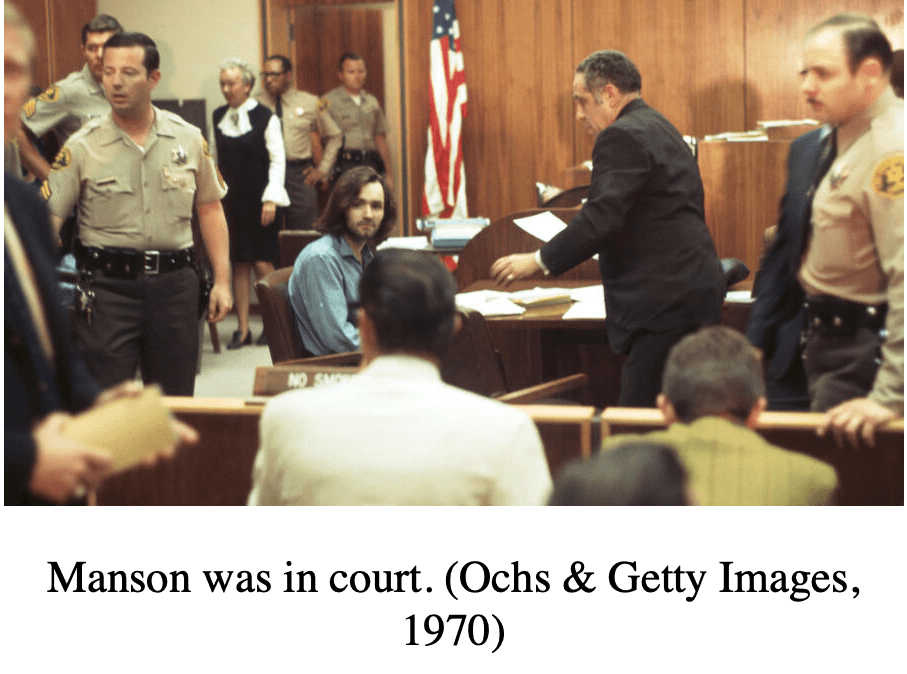
‘I never went to school, so I never grown up to read and write too good, so I have stayed in jail and I have stayed stupid, and I have stayed a child while I have watched your world grow up, and then I look at the things that you do and I don’t understand(Bugliosi & Gentry, n.d.). . . .’
It is self-evident that Manson’s imperfect and uneven childhood experiences had an influence which cannot be negligible on his criminal behaviour, and life course theory explains to us how this specifically happened to some extent.
4.3. The Life Course Theory: A Social-Institution View
The life course theory (or the life course approach) is initially theorised by William Thomas in the late 1920s (Mortimer & Shanahan, 2003). This theory focuses on the influence of an individual’s life experience and the social events it participated (White & Klein, 2007). We have examined the early experience of Manson in Chapter 2. According to this theory, the triggers of his crimes can be generalised in these points:
4.3.a. Childhood Dynamics: the Family
Manson experienced a disintegration of family relationships in his childhood, namely the distinction between his biological and legal father. Commonly, the family carries out the function of primarily socialising an individual via, for example, role modelling in this particular case.
As mentioned earlier, one of Manson’s fathers was a notorious local crook, while the other was sent to prison for robbery. In this situation, no matter whether Manson witnessed the misbehaviour committed by his fathers, he might misinterpret them and assume these socially unacceptable behavioural patterns to be acceptable. This experience allows us to reasonably infer that Manson’s later criminal behaviour may have been based on imitating his father’s behaviour.

Functionalist Talcott Parsons argued that, the “segregated conjugal roles” are the most appropriate and effective way of labour division within the family – which refers to the situation when a woman takes the “expressive (e.g. taking care of family members’ emotions)” role, and the man takes the “instrumental (e.g. working outside)” role (Blundell, 2014). His father failed to fulfil the instrumental role due to the prison sentences. His mother, who was supposed to care for Manson’s emotional development during primary socialisation under this diagram, had also been engaged in a series of criminal behaviour. We do not utterly deny the explanation the formation of individual characters from a biological perspective, but the absence of Manson’s mother might have deprived him of some positive emotions – such as compassion, care and love. These factors engendered Manson’s inadequate socialisation.
Luckily, it is widely acknowledged that other social institutions can also conduct socialisation in one’s later stage of life and compensate for the insufficient primary socialisation. Nevertheless, in Manson’s case, his secondary socialisation experience (schooling) even reinforced the formation of his deformed identity – a mixture of frustration, aggravation and violence, which acted as the basis of his criminal motivation as well.
4.3.b. Schooling experience: the Education
Manson had been sent as a child for his behaviour to Gibault School for Boys – a single-sex school full of corporal punishment and strict regimes and dedicated to correcting juvenile delinquents. As one of Michel Foucault’s critical institutions of discipline, a well-run school should convey society’s moral code to its students effectively, but Gibault School for Boys appeared to be not.
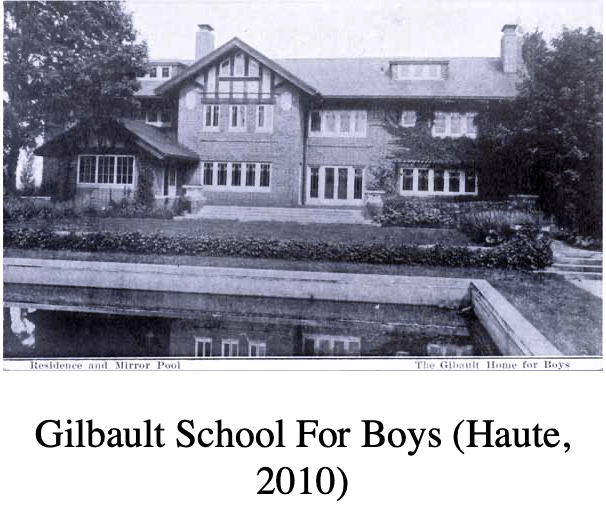
Let us put aside Manson’s encounter in the school and turn our attention to the macro operational structure of the school for young offenders. The corollary is that schools tend to label the most needy juvenile offenders because of their social stigma created by the crimes. They consider these offenders to be incorrigible. These wrong perceptions may lead school authorities to simply resort to force and punishment in the disciplinary process, spirally reinforcing these negative influences, rather than playing the role that a social institution ought to play in this situation – understanding, accommodating and helping to put juvenile offenders back on the right track.
Now we can imagine what Manson would do in this kind of situation. Besides the low educational achievement, which might be attributed to the action on purpose to rebel against the school and teachers, Manson may also have struggled to learn these methods of corporal punishment while being physically punished. This is because it is possible that in the social structure, he assumed and being reflected by the school system, those with more power could use these approaches to maintain their privilege, while those with less power could only protect themselves, and violence was the means of protection. The punishment inspired him to plan the methods used in his later crime and partly explains why the Manson Family’s creation: because he intended to compensate for his will to power through dominating others. More importantly, by employing the same violent means, he can project his childhood-self onto his victims and satisfy his desire by torturing them.
When he could no longer bear these torments, he finally chose to escape from the school and claimed in court that he had “never been to any school”. These factors within his life course eventually led to inadequate socialisation, which emerges when socialisation is incomplete or ineffective (Blundell, 2014), leading to the insufficient construction of one’s social identity.
4.3.c. Career Life: the Media
As we have already known in his bio, Manson has experienced a failure in his musical career. However, did this adverse musical career leave him with nothing to show for it? The answer is no.
It is worth noting that, according to Los Angeles prosecutor Bugliosi, Manson’s prophecy of the end of the world and his justification for starting a race war were inspired by the music of The Beatles (Buddy, 2017). He was also influenced by Bob Dylan and other artists who were active in the hippy movement. In the songs he wrote, he recorded his reflections on social phenomena and his determination that the world had “gone wrong”, – which explains his testimony in court (Stanley, 2019).
I am a mechanical man, a mechanical man
And I do the best I can
Because I have my Family
I am a mechanical boy
I am my mother’s toy
Charles Manson, I Am A Mechanical Man (Manson, n.d.)
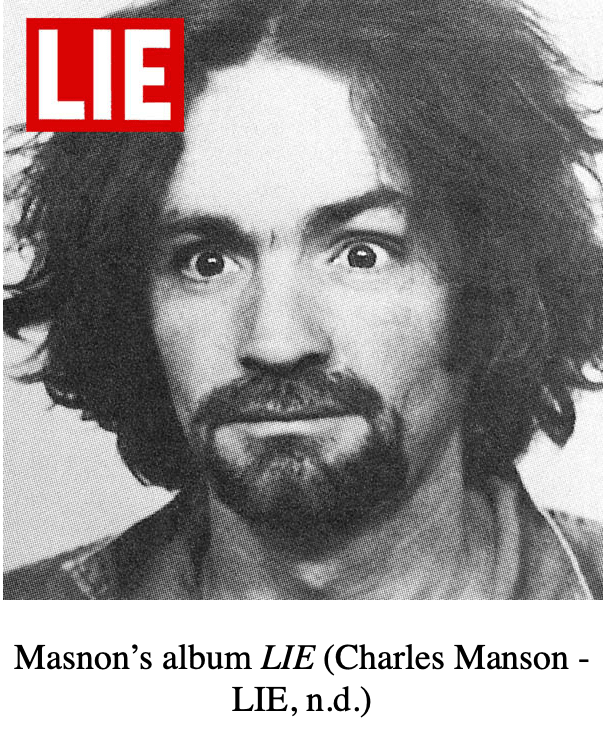
In this paragraph of lyrics, although Manson does not directly express his criticism about society, he does use the metaphor of the ‘mechanical man’ to indicate the alienated and mechanical mode of life of an individual in society, as well as his helplessness and dissatisfaction with the system. Although the influence of music as a medium on Manson may not have been as strong as that of other social institutions, we cannot deny the vital role it played in shaping an individual’s ideology – because the media in modern society permeates almost the entire life of an individual.
5. Conclusion & Reflection
In this article, we examined the influence of different social institutions on an individual’s behaviour, namely religion – the Manson Family, family – a family with criminal parents, education – a violent school and media, and how these influences are externalised through deviant behaviour, using the case of Manson. We have witnessed the influence of nature on an individual in criminal behaviour greater than nurture and the step-by-step progress of an individual towards the abyss.
Due to the time constraints of this in-week study, many questions remain unanswered: for example, what drove members of the Manson Family to join the cult and willingly conform, and how Manson developed this form of extreme racisms. There are also some logical incoherences and incomplete arguments in the article. However, fortunately, we did use the scalpel of sociology to wade through this criminal. There is nothing we can do to track back in time to stop his cruelty or compensate his victims for Manson’s crimes. Nevertheless, with these humble insights, I hope to make some better-than-nothing contribution.
I want to pay tribute to all the victims of the Manson murders. May you rest in peace.
Bibliography:
6abc. (2017, January 4). Official: Charles Manson alive amid reports he was hospitalized. 6abc Philadelphia. Retrieved June 1, 2023, from https://6abc.com/charles-manson-family-dead-hospitalized/1684863/
BBC News. (2017, November 20). Charles Manson death: Where are the Family members now? Retrieved May 31, 2023, from https://www.bbc.com/news/world-us-canada-42056252
Blundell. (2014). Cambridge IGCSE Sociology Coursebook [Paperback]. Cambridge University Press.
Buddy (Director). (2017). Charles Manson: The Final Words (Documentary) [Video]. Pyramid Productions.
Brookes. (2022, November 3). Cesare Lombroso: Theory of Crime, Criminal Man, and Atavism. Simply Psychology. Retrieved June 2, 2023, from https://www.simplypsychology.org/lombroso-theory-of-crime-criminal-man-and-atavism.html
Bugliosi, V., & Gentry, C. (1992). Helter Skelter: The True Story of the Manson Murder. Norton.
California Department of Corrections and Rehabilitation. (n.d.). Charles Manson in a 1971 prison mugshot. Wikimedia Commons. https://commons.wikimedia.org/wiki/File:Charles_Manson_1971.jpg#/media/File:Charles_Manson_1971.jpg
Charles Manson – LIE. (n.d.). Discogs. https://www.discogs.com/release/2189196-Charles-Manson-LIE
CNN. Charles in the prison. (n.d.). CNN. https://edition.cnn.com/2017/11/20/us/charles-manson-dead/index.html
Dorsey (Director). (2009). The Six Degrees of Helter Skelter [Video]. Youtube. Retrieved May 31, 2023, from https://www.youtube.com/watch?v=3ZELGmN_4hc
Evolution Of Charles Manson Family: Formation And Crimes. (2021, September 28). Edubirdie. Retrieved May 29, 2023, from https://edubirdie.com/examples/evolution-of-charles-manson-family-formation-and-crimes/
Fox News. (2015, November 19). Judge allows tapes to be released to LAPD in probe into possible unsolved Manson murders. Retrieved May 31, 2023, from https://www.foxnews.com/us/judge-allows-tapes-to-be-released-to-lapd-in-probe-into-possible-unsolved-manson-murders
Gill, L. (2017, November 16). Charles Manson Was a White Supremacist. Newsweek. https://www.newsweek.com/charles-manson-was-white-supremacist-lets-not-forget-713915
Guinn, J. (2013). Manson: The Life and Times of Charles Manson. Simon & Schuster.
Guinn, J. (2013, August 6). Long Before Little Charlie Became the Face of Evil. The New Your Times.
Retrieved May 30, 2023, from https://www.nytimes.com/2013/08/07/books/a-new-look-at-charles-manson-by-jeff-guinn.html
Haute. (2010, February 9). Terre Haute Postcards – Gibault School for Boys (2).
Hunter, J. (2015, January 22). Charles Manson – Hoosier Juvenile Dilenquent. The Weekly View.
Internet Accuracy Project. (2012, January 1). Charles Manson. Retrieved May 31, 2023, from https://www.accuracyproject.org/cbe-Manson,Charles.html
Manson. (n.d.). I Am A Mechanical Man Lyrics by Charles Manson. I Am a Mechanical Man Lyrics by Charles Manson. Retrieved June 1, 2023, from https://www.streetdirectory.com/lyricadvisor/song/uuefej/i_am_a_mechanical_man/
Mortimer, & Shanahan. (2003). Handbook of the Life Course. Springer.
NBC News. What ever happened to the other Manson family cult members? (n.d.). NBC News. https://www.nbcnews.com/news/us-news/what-ever-happened-other-manson-family-cult-members-n556561
Ochs & Getty Images. (1970, June 25). American criminal and cult leader Charles Manson sits at the defendant’s table at the Santa Monica Courthouse for a hearing regarding the murder of music teacher Gary Hinman. AETV.
Pavlica, C. (2020, July 22). Charles Manson and His Mom. TV Fanatic. https://www.tvfanatic.com/gallery/charles-manson-and-his-mom/
People v. Manson. (n.d.). Justia Law. https://law.justia.com/cases/california/court-of-appeal/3d/61/102.html
Reuters, R. (2023, March 4). Linda Kasabian, Former Manson Family Member, Star Witness at Murder Trial, Dead at 73. Times of San Diego. Retrieved May 31, 2023, from https://timesofsandiego.com/crime/2023/03/03/linda-kasabian-former-manson-family-member-star-witness-at-murder-trial-dies-at-73/
Stanley, A. (2019, July 24). The Strange History Of Charles Manson’s Failed Music Career. Birth.Movies.Death. https://birthmoviesdeath.com/2019/07/24/the-strange-history-of-charles-mansons-failed-music-career
Terre Haute Postcards – Gibault School for Boys (2). Retrieved June 1, 2023, from https://brisray.com/th/tpcards127.htm
Vox. (2019, August 7). The Manson Family murders weren’t a countercultural revolt. They were mainstream America. Retrieved May 31, 2023, from https://www.vox.com/2019/8/7/20695284/charles-manson-family-what-is-helter-skelter-explained
Waxman, O. B. (2019, July 26). Why Did the Manson Family Kill Sharon Tate? Here’s the Story Charles Manson Told the Last Man Who Interviewed Him. Time. Retrieved May 31, 2023, from https://time.com/5633973/last-manson-interview/
White, & Klein. (2007). Family theories (3 ed). Sage.
Wilkins, F. (n.d.). Tate LaBianca Crime Scene Photos. Tate LaBianca Crime Scene Photos. https://www.reelreviews.com/shorttakes-56/morbidly-hollywood-no-ad/labiancacrimescene





 The Mono Archive

Leave a comment